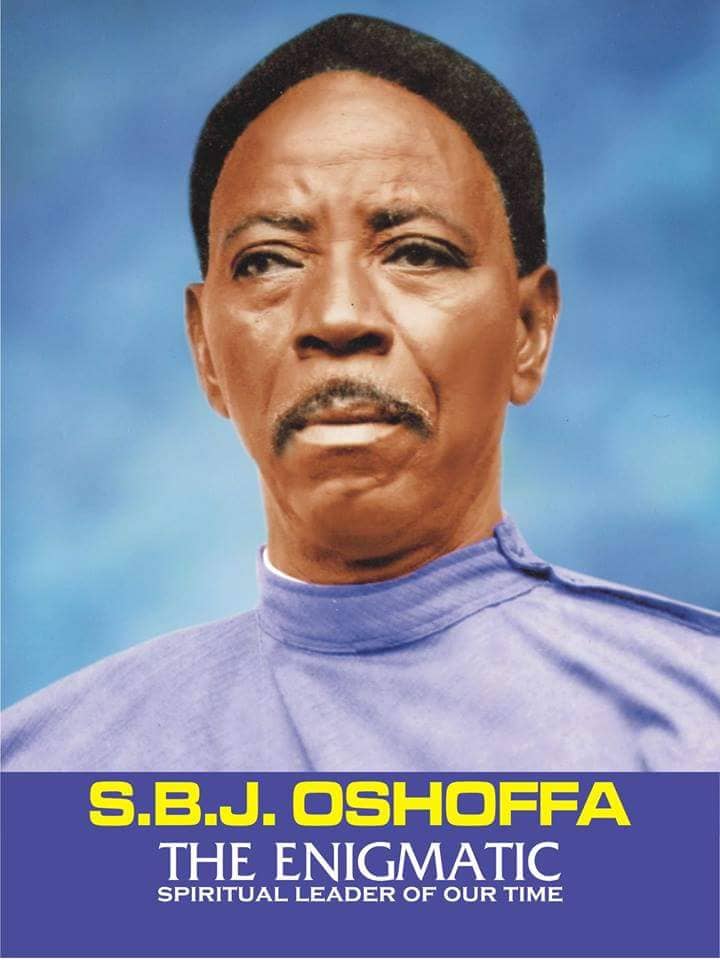
Saint Samuel Bilewu Joseph(SBJ) Oshoffa
1909 to 1985
Oshoffa, Samuel Bilewu Joseph(SBJ)
1909 to 1985
About Me
Following the scramble for Africa and the subsequent partitioning of the continent in accordance with the decisions of the Berlin Conference in 1885, people of the same tribe, with the same culture and speaking the same language were forcibly and unjustifiably separated to conform to the wishes of the imperialists. As a result, the embattled town of Imeko, hometown of Oschoffa’s mother, and Dasatre, his father’s hometown, in spite of their common culture, language and history, were unjustifiably separated by the imperial powers: Imeko was accordingly placed under British authority in the colony of Lagos while Dasatre was made part of the French colony of Dahomey. The geographical similarities between these two places cannot be over-emphasized. The climate, vegetation and soil are similar. The human activities especially in the field of agriculture and palm oil cultivation which were basically on a subsistence level are the same in the two places. Similarly, the cultural bond between Imeko and Dasatre could be seen in the common language of the Egbado stock of the Yoruba people spoken in both places and the intermarriages between them.
Oral tradition claims that the parents of Daddy Osofa (Oschoffa’s grandparents) namely Pa Ojo and Mama Kosina emigrated from Abeokuta and settled down at Dasatre. It was at Dasatre that Daddy Osofa was born. The name Oschoffa has its roots in the Yoruba proberb Oju ki i se ofa ti ota le ta bani ka subu which means: “The eye is not an arrow that the enemy can use to cause one’s death.” This expression was shortened by the Yoruba to “Osofa” which was further anglicized, becoming “Oschoffa.”
According to oral tradition, Daddy Osofa was a polygamist and Madam Toun Alake Iyafo was one of his wives. Madam Alake Iyafo hailed from Imeko, an Egbado town within the Ogun State of Nigeria. The most striking aspect of Daddy Osofa’s married life was that it was estimated that he had thirty-nine children. But sadly enough, with the exception of Oschoffa, none of them reached adolescence. Furthermore, all the children except Oschoffa were females. Daddy Osofa faced two serious problems: first, the loss of his children in infancy and second, his near inability to produce a male child. However, considering the high rate of infant mortality in Africa in those days, could it have been caused by lack of proper medical attention? Could it have been caused by an unhealthy environment and poor sanitation? But notwithstanding the inadequacy of the health care system at that time, it seems inconceivable to ascribe the loss of thirty-nine children within two decades to the lack of proper medical attention and poor sanitation. Could it also have been caused by forces more powerful than Daddy Osofa?
Answering any of these questions requires an understanding of African traditional religion, cultural heritage, social ethics as well as the environmental conditions at that time. With regard to African beliefs, the existence of a Supreme Being possessing the power of life and death over all mortals is widely accepted. It may be said that the real problem that Daddy Osofa faced was his inability to produce a male child who would inherit his property after his death. This was in line with the Dahomean [6] culture which gave the inheritance to the firstborn son. It is important to note that patrilineal system of inheritance is common in West Africa with the possible exception of the Akans of Ghana and Ivory Coast who practice the matrilineal system.
Birth of S. B. J. Oshoffa
Daddy Osofa was one of the early converts to Christianity in Porto Novo and in the light of his domestic problems he prayed ceaselessly to God to give him a baby boy who would live to inherit his wealth and immortalize his name after his death. It was therefore not very surprising that in 1909 in answer to Daddy Osofa’s prayers Mama Alake Iyafo safely delivered a male child. The joy with which Daddy Osofa received the news of the birth of his first son cannot be described. In accordance with Methodist practice, the child was blessed in the church and later christened as Samuel Bilewu, a Christian name with the biblical meaning “gift of God” and an indigenous name derived from a proverb in the Yoruba language Bi ‘le aiye wu ko gbe, sugbon mo mo wipe mo ti toro re lodo Olorun which means: “If the world pleases the child let him stay, but I know I’ve asked God for you.”
Among the Yoruba people and most West African tribes, there is a strong belief that some children called Abiku are unstable and choose to come and go. These children invariably die during infancy. Thus the name Bilewu clearly suggests that the child born to Daddy Osofa was believed to be one of these children born to the family but who died in infancy. The naming of a child in Africa and particularly in Yorubaland is more than just a convenient label for identification. Names are given often in relation to the circumstances, religion, time, and conditions under which a child is born.
In appreciation and fulfillment of his vows to God, Daddy Osofa sent Samuel Bilewu Osofa to an evangelist called Pastor Nathaniel Yansunu of the Methodist mission in Porto Novo when the boy was seven years old, for spiritual training and to learn Christian principles. Osofa did this because he feared for the survival of his only son, should the child reside at his house, especially as he had lost all of his other children between birth and puberty. However, at the early age of seven, S. B. J. Osofa was too young to be sent away from his parents and so he could not cope with the domestic challenges of the mission house and he chose to return home.